On the new single, Johnson imparts, “‘Live to Ride’ is one of my favorite songs off the new record. It plays to my very young, testosterone-driven self, looking up to motorcycle riders, and wanting to be as badass as them. After I got my own, I realized that riding was more than being badass, it was a culture, a community, and a family you can depend on. So, this is a celebration of the motorcycle culture.”
Born and raised in the rural community of Lakeside in San Diego County, California, Johnson grew up balancing life between Future Farmers of America, horseback riding, surfing and skateboarding. Raised among cattle, rodeos, and wide-open spaces, he proudly identifies as an “urban cowboy”—someone
Live to Ride” draws on your early fascination with motorcycle culture. How did your personal perspective on riding shift once you got your own bike and experienced that community firsthand?
My perspective changed in that, a lot of the negative stereo types I had heard about bikers, I found not to be true. Motor Cycle clubs and independents are a brotherhood of people who have a passion for motor cycles and personal independence. They have a code of conduct which is based in strength and respect.
Your forthcoming album is titled Tales From The Cowboy Palace. What made now the right moment to step back into the spotlight as a solo artist after so many years working behind the scenes?
Well I never stopped performing. I just kept it local and worked behind the scenes because I had a family. I wanted to raise my son and be home every night. I got to see all of his baseball and football games. I got to see him sing in the choir, play in the school band. I got to travel all over the United States supporting him in travel baseball and help him make the Dean’s list. I watched him earn a scholarship to play baseball in college, I took him to every practice, game, showcase and played catch with him every night in the back yard. I would not have traded that time for anything. These were the happiest days of my life. I loved just being a middle aged dad from the valley. He is all grown up now. My son and my wife said to me that I had been the best husband and dad, and I deserved another shot at my dream. I was told by a recording engineer buddy of mine that it is never too late, if you have talent, so this record is my final opus
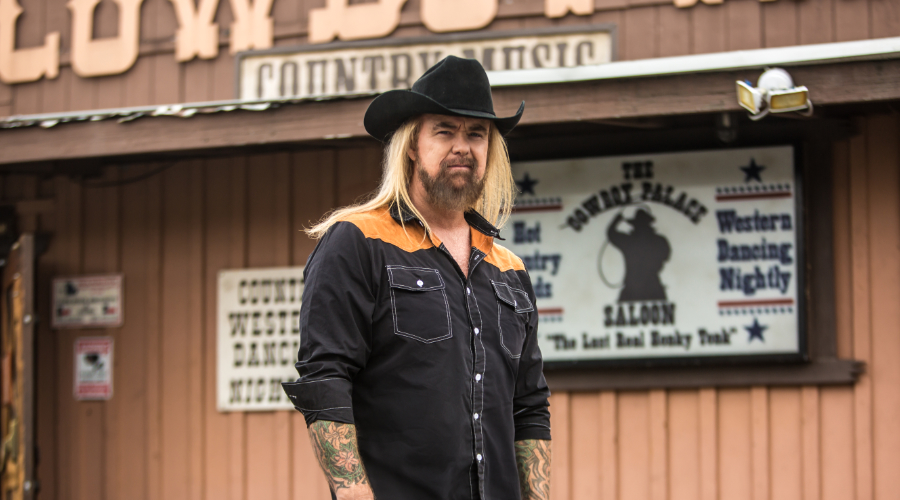
You went from performing at the famed Cowboy Palace to actually purchasing the venue. How has owning such an iconic country spot shaped your approach to writing and performing your own music?
There is nothing that can replace Honky Tonk experience. Playing 5 hours a night, five times a week, for 20years, taught me how to work a room. It taught me to get off the set list and adjust to the audience in real time. As a band leader, I learned how to read the dance floor as to see what’s working. If I got them dancing I extend the song, if ain’t working, then I cut it short and move on. It’s all about finding a right balance of classic country and modern country. A good band leader will figure out what the dance teachers are teaching and play accordingly. I learned this to translate to making records as well. The best records lifts listener up and bring them down. For instance, I might compose a love song, a sad song, a sexy one, I wanna hook up song, a rowdy Friday night anthem or bar brawling bar fighter song
Your career includes touring with a remarkably diverse lineup—from John Fogerty and Styx to Chaka Khan and System of a Down. How have those vastly different genres and stage environments influenced your country sound?
Well that is just a small list of artists I have worked with on tour, but I provide equipment and crew for Stage Coach, Coachella, The Hollywood Bowl, and The Greek Theater on a regular basis. I am involved in recording Production at Paramount Recorders, Encore, East West, Conway Recording studios to name a few. It is hard for me to pin point all my influences. This has been a problem for me in branding myself in the past. Thankfully Country music has become a big tent of sounds. I have learned a lot from other artists about writing, recording music, how to get sounds, and how the tracks are built etc. You have to start with a good song first. If you want to appeal to a certain genre then it comes down to sound elements used. On this record I used pedal steel, fiddle, piano, and acoustic guitar. Those are clearly country influences. I used Organ which brings in the soulful gospel feel. I used a Marshall amp for most the electric leads which brought in the classic rock tone. I do not speak with a Southern accent therefore I do not sing with one. I am from Southern California so that would be silly. I have sort of a natural bluesy feel that can sound pretty Rock if I push it or sort of pop with a light approach and I used those three approaches on these songs.
You describe yourself as an “urban cowboy” who balances a suburban life with a rural spirit. How does growing up in Lakeside with rodeos, surfing, and FFA manifest in your songwriting today?
Lakeside California definitely contributed to my love of Country Music. The whole town was crazy about Country Music. KSON was the only radio station anybody I knew was listening to as a teenager. My East County home town had a Rodeo. My high school had a big AG department and Futures Farmers of America program. I raised a steer each year and took them to the Country Fair. I had a horse and the neighborhood kids did as well. I remember we would take long trail rides together and, sometimes a few of us would meet in my back yard on horseback and practice roping. It sounds weird perhaps, but Surfing was another passion, even though the surf was about 25 miles west. I used to ride the public bus to the beach. Later when I could drive my friends and I would chase the swell from Tijuana up to Ventura County line depending on where the waves were best breaking. I believe my song writing today is colored by the lens of my own life adventures.
Having worked as a guitar tech, venue sound engineer, and business owner, how does your deep technical knowledge of live music change the way you produce and record your own material?
As a business owner I have learned that people’s time is money, even if they are your friends. It is always best to compensate players something even when self-financed. You have the fees established a head of time. Live sound and recording records are the same. It is all about good tones and a balanced level between the instruments and vocals. This is all achieved through the use of of gain structure, compression, EQ, reverbs, delays, and various effect. My recordings have evolved over the years with my deeper understanding of these signal chains. I have also learned how to achieve various guitar sounds with combinations of guitar pedals and amplifiers.
With “Live to Ride” releasing on August 28 and the full album dropping on December 11, what do you hope listeners take away from this new chapter of your career?
I hope they take way that I am an artist who has lived a life and still has something to say. I hope people can relate and see something in their own lives in my music. But mostly I just want provide a nice melody for the listener to give them a brief pause to enjoy some music